 Blender
 Cinema 4D
 Arnold
 3ds Max
 Houdini
 V-Ray
V-Ray Maya
Maya Unreal Engine
 Nuke
NukeBest AI 3D Modeling Tools in 2026: Text-to-3D, Image-to-3D
 Ryan Thompson
AI 3D modeling is changing how artists, game developers, product designers, and studios create early 3D assets. Instead of starting every model from a blank scene, creators can now use text prompts, reference images, sketches, or product photos to generate a first-pass 3D model in minutes.
The results are not always production-ready, but they are becoming useful for concept exploration, game props, 3D printing tests, e-commerce previews, and early visual development. In this guide, we look at some of the best AI 3D modeling tools in 2026, what each tool is good at, and where AI-generated models still need cleanup before rendering or production.
What Is AI 3D Modeling?
AI 3D modeling uses artificial intelligence to generate or assist with 3D assets. Depending on the tool, users can create models from text prompts, single images, multiple reference views, sketches, or existing 3D files.
Most AI 3D modeling tools focus on one or more of these workflows:
| Workflow | What It Does | Common Use Cases |
| Text to 3D | Generates a 3D model from a written prompt | Game props, concept assets, quick prototypes |
| Image to 3D | Converts a 2D image into a 3D model | Product previews, characters, collectibles, props |
| Multi-view to 3D | Builds a model from several reference angles | Higher-fidelity objects, product design, characters |
| AI texturing | Adds or changes textures with prompts | Game assets, stylized looks, material exploration |
| AI-assisted cleanup | Helps with retopology, repair, conversion, or rigging | Preparing assets for Blender, Unity, Unreal Engine, or 3D printing |
Can AI Really Create 3D Models?
Yes, AI can create usable 3D models, especially for early-stage assets, stylized objects, simple props, toys, collectibles, and visual concepts. Many tools now export common formats such as GLB, FBX, OBJ, STL, USDZ, or 3MF, which means the models can be opened in Blender, Maya, Unity, Unreal Engine, slicers, or web-based 3D viewers.
However, AI-generated 3D models still need checking. Topology may be uneven, textures may require editing, scale can be inaccurate, and complex production assets often need manual cleanup before animation, simulation, or final rendering.
10 Best AI 3D Modeling Tools in 2026
1. Meshy AI
Meshy is one of the most complete AI 3D model generators for general creators. It supports text-to-3D, image-to-3D, AI texturing, animation, and export workflows, making it useful for game developers, 3D artists, educators, and prototyping teams.
Meshy is especially strong when you want to move quickly from an idea or reference image to a textured asset that can be inspected, downloaded, and refined. Its export options include formats commonly used in Blender, Unity, Unreal Engine, AR, and 3D printing workflows.

Best for: all-around AI 3D generation, game assets, quick prototypes, texturing
Features: text-to-3D, image-to-3D, AI texturing, rigging/animation tools, multiple export formats
Limitations: generated meshes still need review for final production use
2. Tripo
Tripo is another major AI 3D modeling tool, with support for text, single-image, and multi-view 3D generation. It is often discussed for high-detail outputs, API access, and flexible post-processing options such as retopology, texture generation, segmentation, and format conversion.
For creators who want more control over model generation and pipeline integration, Tripo is worth testing. It can be useful for product concepts, props, character drafts, and workflows where developers need API-based 3D generation rather than only a browser tool.
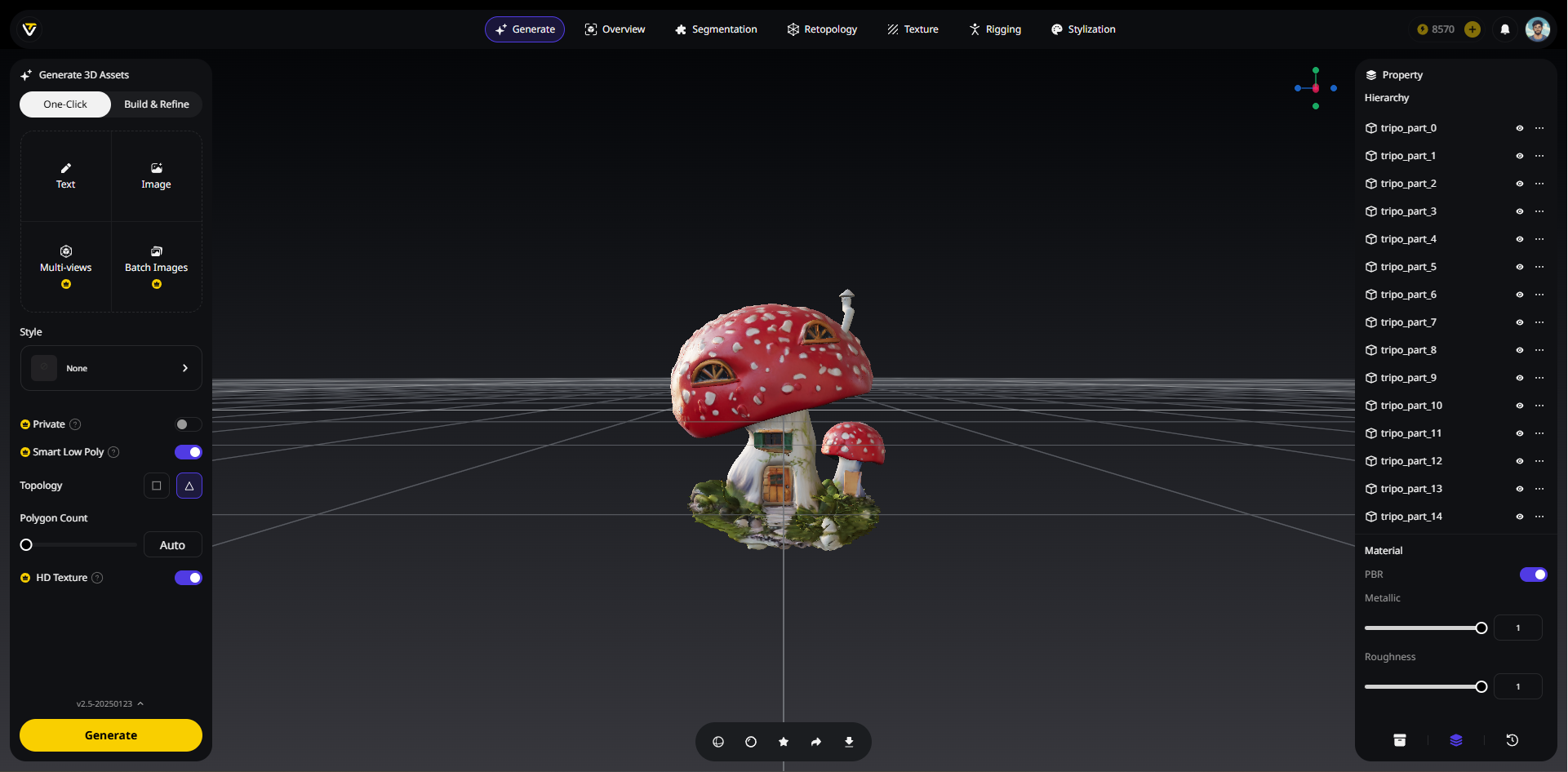
Best for: high-detail model generation, API workflows, multi-view input
Features: text-to-3D, image-to-3D, multi-view to 3D, retopology, conversion, API access
Limitations: advanced options may require more technical setup
3. Rodin
Rodin, developed by Deemos, focuses on high-quality 3D generation from text and images. It is often used for characters, creatures, collectibles, and more sculptural assets where shape and visual detail matter.
Rodin supports text-to-3D and image-to-3D workflows, including multiple image inputs. It can be a strong option for artists who want detailed first-pass models that can later be refined in traditional 3D modeling software.

Best for: characters, creatures, sculpt-like assets, detailed concepts
Features: text-to-3D, image-to-3D, multi-image generation, higher-detail texture options
Limitations: not every generated model will be animation-ready without cleanup
4. Sloyd
Sloyd is useful for creators who need fast, game-ready, stylized, or low-poly assets. Its text-to-3D workflow focuses on generating export-ready models that can be used in game engines, web 3D, Blender, or 3D printing workflows.
Compared with some image-to-3D tools, Sloyd is more appealing when you want predictable objects, props, and stylized assets rather than highly realistic hero models. It can be especially useful for indie games, prototypes, education, and real-time projects.

Best for: game props, low-poly assets, stylized models, fast iteration
Features: text-to-3D, style presets, export formats for engines and 3D printing
Limitations: less suitable for highly specific photorealistic or CAD-level assets
5. Kaedim
Kaedim is different from many one-click AI 3D generators. It is built more for studios, brands, and production teams that need higher-quality 3D assets with review, revision, and artist support.
Its workflow combines AI with human-in-the-loop refinement, which makes it more suitable for professional pipelines than casual prompt-based tools. For game studios, e-commerce teams, product visualization, and branded 3D content, Kaedim can help turn concepts, sketches, product photos, and references into assets that are closer to production needs.
Best for: studios, brands, game production, e-commerce 3D assets
Features: reference-based asset creation, revisions, artist review, production-oriented workflow
Limitations: less of a quick free playground; better suited to teams with asset volume or quality requirements
6. Masterpiece X
Masterpiece X is designed as a creator-friendly AI 3D generation and editing platform. Its Generate tool focuses on text-to-3D creation for characters, animals, and objects, with a simple browser-based workflow.
It is useful for creators who want to explore ideas quickly without learning complex 3D software first. Generated assets can help with early concepts, game prototypes, virtual worlds, and creative experiments.

Best for: beginners, rapid concept exploration, characters and objects
Features: text-to-3D generation, browser access, creator-friendly workflow, 3D editing ecosystem
Limitations: not intended to replace high-end manual modeling for exact production assets
7. TRELLIS
TRELLIS is a 3D generation research project from Microsoft Research and collaborators, known for image-to-3D generation and structured 3D latent representation. It is more relevant to technically curious creators, researchers, and developers than to casual users looking for a polished commercial app.
Because TRELLIS is tied to open research and community implementations, it can be interesting for users who want to test newer AI 3D generation methods or build local/custom workflows.

Best for: research, open-source exploration, technical users
Features: image-to-3D generation, open research ecosystem, high-quality 3D asset experimentation
Limitations: less beginner-friendly than commercial web tools
8. Image3D
Image3D is a lightweight AI 3D model workbench focused on turning images or prompts into downloadable 3D models. It supports browser preview and exports such as GLB, OBJ, STL, and PLY, making it useful for quick tests.
This type of tool is helpful when you have a product photo, concept image, prop, character, or simple object and want to see whether it can become a usable first-pass model.
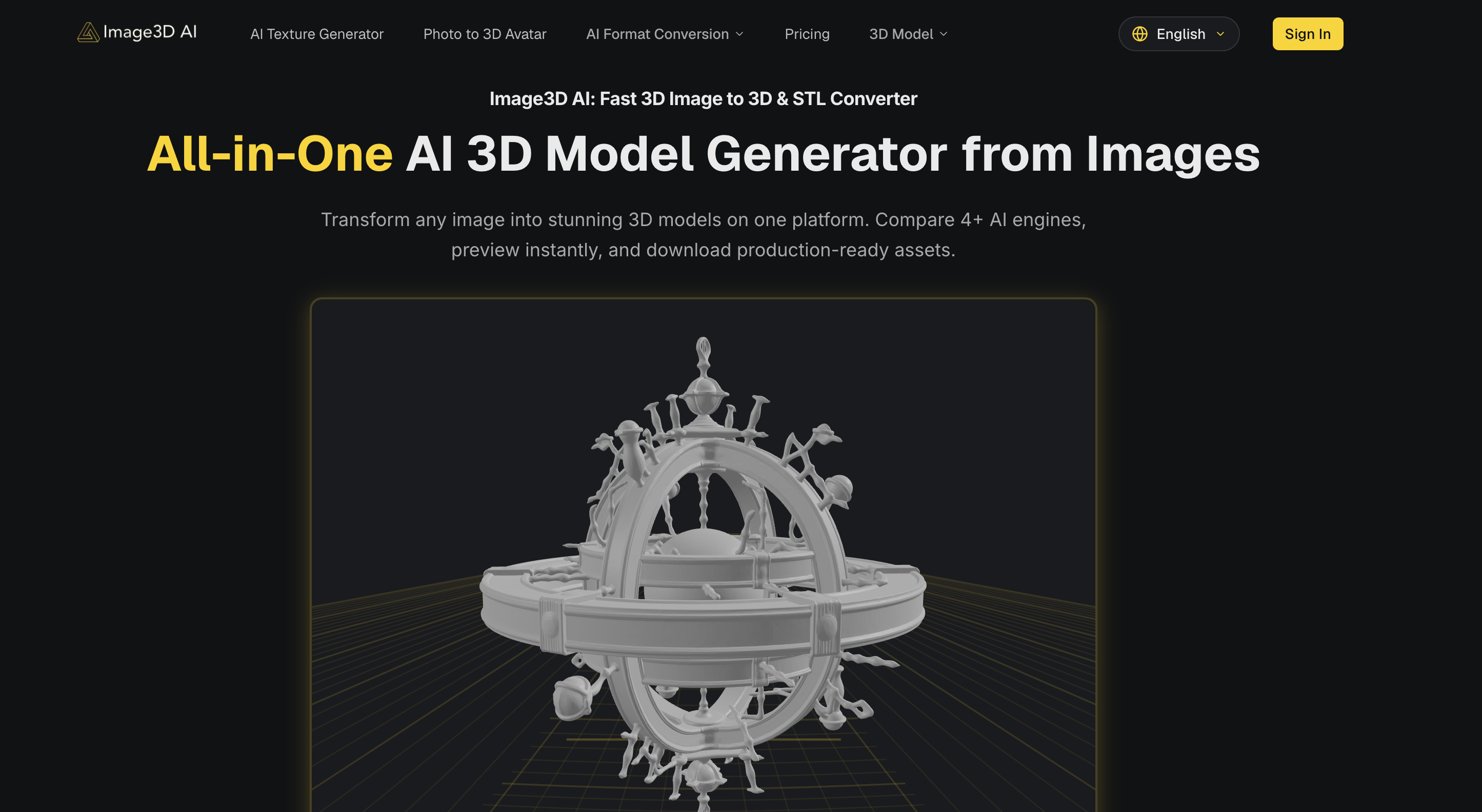
Best for: image-to-3D tests, product previews, quick prototypes
Features: image input, text input, browser preview, GLB/OBJ/STL/PLY export
Limitations: output should be checked for mesh quality, scale, and print readiness
9. Text3D.ai
Text3D.ai focuses on prompt-based 3D generation with export and refinement tools. It supports text and image inputs and offers several output formats for game development, product concepts, web 3D, AR, and 3D printing.
Its value is in connecting generation with practical asset handling, including conversion, repair, remeshing, and measurement tools. That makes it more useful than a simple demo if you need to test whether a generated model can move into a real workflow.
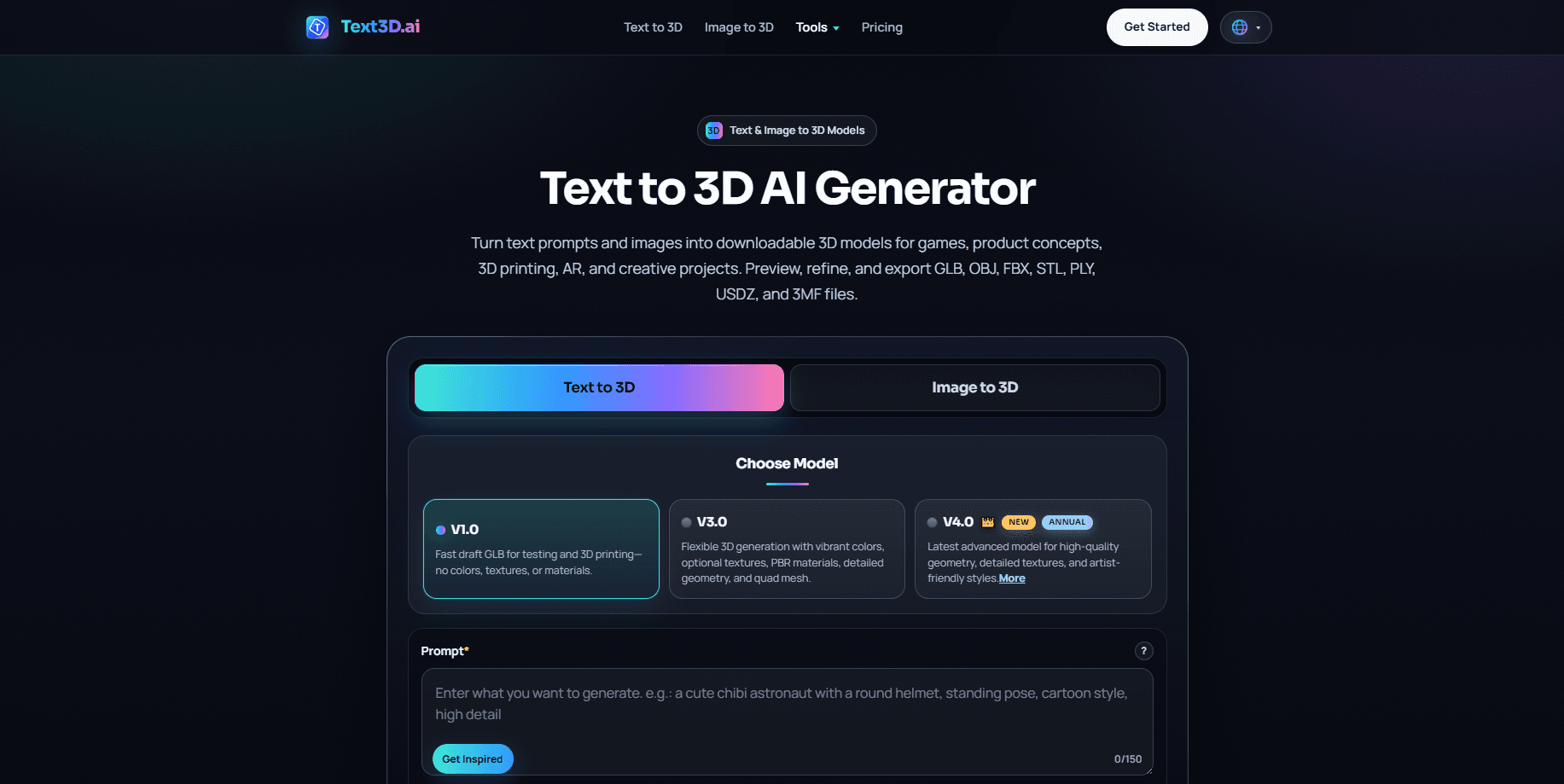
Best for: text-to-3D assets, format flexibility, fast prototyping
Features: text/image input, GLB/OBJ/FBX/STL/PLY/USDZ/3MF export, repair and conversion tools
Limitations: complex assets may still require manual editing in Blender or another DCC tool
10. SculptChat
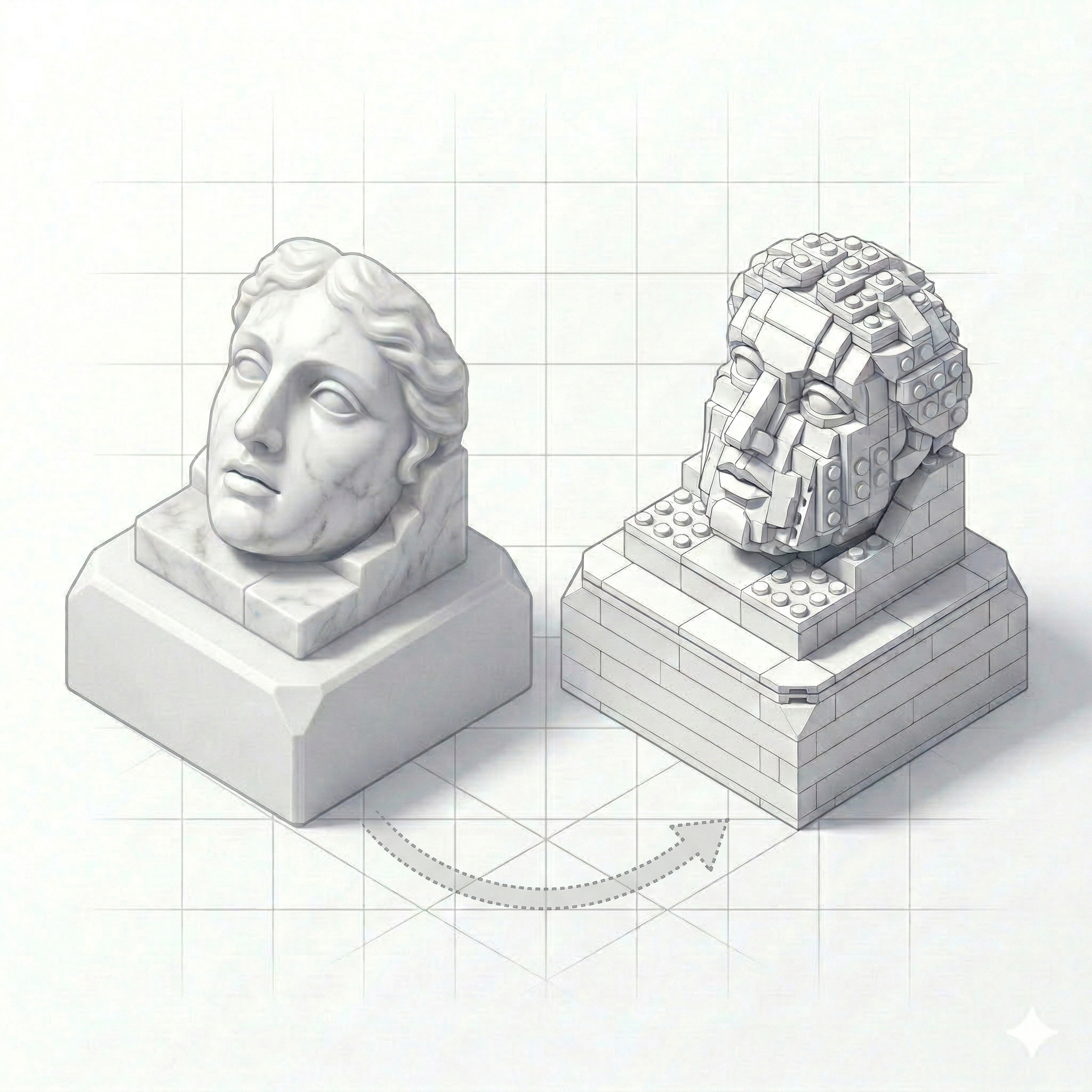
SculptChat is focused on creating 3D-print-ready models from images or text descriptions. It is useful for hobbyists, makers, and anyone who wants an STL file for slicing rather than a game-ready textured asset.
For 3D printing, this workflow is different from game or animation pipelines. The model needs to be watertight, printable, and checked for overhangs, supports, scale, and wall thickness. SculptChat’s positioning makes it more relevant for print-focused users than general 3D artists.
Best for: 3D printing, STL generation, hobbyist models
Features: image-to-3D, text-to-3D, STL/GLB export, print-focused workflow
Limitations: less suitable for advanced animation, VFX, or complex production scenes
Where AI 3D Modeling Works Best
AI 3D modeling works best when speed, exploration, and visual direction matter more than perfect technical control. It is especially useful for early concept modeling, game props, background assets, product visualization drafts, e-commerce previews, stylized characters, 3D printing experiments, and educational projects. In these cases, AI helps artists and teams move from an idea to a visible 3D form much faster, so they can compare directions, test proportions, and decide which assets are worth refining.
For studios and creators, the real value is not that AI replaces traditional modeling, but that it shortens the first stage of asset creation. A generated model can become a base mesh, a visual reference, a pitch asset, or a quick prototype before artists rebuild, clean, texture, or optimize it for the final workflow.
Where AI 3D Modeling Still Falls Short
AI-generated 3D models are improving quickly, but they are not always ready for professional production. Topology can be uneven, UVs may need repair, textures can stretch or lose detail, and the model’s scale, edge flow, or material setup may not match the needs of animation, rendering, game engines, or 3D printing. Single-image generation can also miss important side or back details because the AI has to guess what it cannot see.
For serious production work, artists still need to inspect and refine AI-generated models in tools such as Blender, Maya, ZBrush, Cinema 4D, or other DCC software. The model may look good in a web preview, but final scenes require clean geometry, reliable materials, proper lighting behavior, and file formats that fit the actual pipeline.
How AI-Generated 3D Models Fit Into Rendering Workflows
AI 3D modeling can speed up the early asset creation stage, but the rendering workflow still needs proper scene setup, cleanup, lighting, materials, and final quality control. A model generated from text or images may look impressive in a browser preview, but once it is imported into Blender, Maya, Cinema 4D, 3ds Max, or another DCC tool, artists still need to check the mesh, fix topology issues, adjust UVs, rebuild materials, and make sure the asset works inside the full scene.
A practical workflow usually starts with generating a first-pass model in an AI 3D modeling tool, then refining it in professional 3D software. After that, artists can add accurate materials, lighting, cameras, animation, simulations, and render settings. This step is especially important for product visualization, animation, VFX, architectural visualization, and commercial 3D projects, where a quick AI-generated asset still needs to match the final creative and technical requirements.
When the scene becomes heavy, final rendering can put a lot of pressure on local hardware. High-resolution textures, complex lighting, large environments, simulations, animation frame ranges, and tight delivery schedules can all increase render time. In this stage, using a cloud render farm such as Fox Renderfarm can help artists and studios render AI-assisted 3D projects more efficiently without relying only on local machines.
Fox Renderfarm supports popular 3D software and renderers, making it a practical choice when AI-generated assets are brought into larger production scenes. Whether you are testing a Blender scene, preparing animation frames, or rendering a commercial visualization project, Fox Renderfarm can provide scalable cloud rendering power to help speed up final output and keep the workflow moving.

FAQs about AI 3D Modeling Tools
What is the best AI 3D modeling tool in 2026?
There is no single best AI 3D modeling tool for every workflow. Meshy is a strong all-around option, Tripo is useful for high-detail and API workflows, Rodin is strong for characters and sculptural assets, Sloyd is good for game props, and Kaedim is better suited to studio-level production needs.
Can AI make 3D models from text?
Yes. Text-to-3D tools can generate 3D models from written prompts. The quality depends on the tool, prompt clarity, model complexity, and whether the asset needs to be used for games, animation, rendering, or 3D printing.
Can AI turn an image into a 3D model?
Yes. Image-to-3D tools can convert product photos, concept art, character images, sketches, or object references into first-pass 3D models. Clean single-subject images usually work better than busy scenes or images with hidden details.
Are AI-generated 3D models ready for production?
Some AI-generated models are usable for prototypes, previews, and simple assets, but production work usually requires cleanup. Artists should check topology, UVs, textures, scale, materials, and file compatibility before using AI models in final scenes.
Can AI 3D models be used in Blender?
Yes. Many AI 3D tools export formats such as GLB, FBX, OBJ, or STL, which can be imported into Blender. After import, artists can edit geometry, adjust materials, retopologize the mesh, add lights, animate the asset, or prepare it for rendering.
Conclusion
AI 3D modeling tools are becoming practical parts of modern 3D workflows. They are especially useful for fast concept creation, game props, product previews, 3D printing tests, and early asset development.
The best results come when AI is treated as a starting point, not the final step. A generated model still needs an artist’s eye, proper cleanup, good materials, scene integration, and reliable rendering. Used well, AI 3D modeling can shorten the path from idea to asset while leaving room for the craft that makes 3D work production-ready.