

Fox Renderfarm, a leading cloud rendering service provider and render farm in the CG industry, recently had the pleasure of interviewing Konstantins Visnevskis and Mārtiņš Upītis at IAICC. As the creative and technical minds behind the stunning visuals of the animated movie "Flow," we discussed their journey from art school to technical direction, the evolution of their careers using Blender, and the technical challenges faced in "Flow."
Fox Renderfarm: Hi Konstantins and Mārtiņš, thank you for accepting this interview. Could you briefly introduce yourselves?
Mārtiņš: We are Konstantins Visnevskis and Mārtiņš Upītis. Both of us work in the Technical Artist department for the movie "Flow."
To give a bit more background, I am the co-founder of Physical Addons, where we create addons for Blender—that is my primary business. Whenever Director Gints Zilbalodis asks for help with his movies, I jump in to assist. I was also a 3D freelancer for nearly 20 years, mostly working on TV commercials, and in my free time, I lecture at the Art Academy of Latvia.
Mārtiņš Upītis
Konstantins: My background is quite similar. We actually went to the same school.

Konstantins Visnevskis
Fox Renderfarm: How did you start your career in animation and eventually become a Technical Artist?
Konstantins: Well, I began doing 3D a long time ago, even before I got into art school—around 1992 or 1993. I started with the first 3D packages available to the average consumer. I was really excited at the time and learned 3ds Max.
Eventually, someone suggested I should go to art school. I had already made some short films, so I entered art school with the intention of learning 3D. Ironically, I became a painter and an artist instead! But that training helped a lot, of course; now I can do basically everything.
Regarding becoming a Technical Artist, as we discussed yesterday, people rarely explicitly choose to be a Technical Artist. Usually, there are a lot of artists, and if some of them can do technical tasks, they are often pressured into that role because nobody else can do it. That’s essentially what happened to me.
Mārtiņš: I also started with a passion for computer games. When I was a small kid, I wanted to create games, but the internet was just starting, and I had no idea where to begin. So, I started with art and became a painter.
In art school, we had a teacher who taught us some 3D basics, primarily using Maya. That was my introduction to the field. Later, when I got my first computer, I needed software. Maya was too expensive, and it wasn't accessible for my specific setup. However, Blender was available. I got Blender, which included the Blender Game Engine, and that's how I got started with everything.
Over the years, I started doing more things that sat somewhere between programming and 3D art. In the end, I somehow fell into the category of Technical Artist.
Fox Renderfarm: We have questions about the flood scenes in Flow. Martins, as a Technical Artist, you built a Blender plugin to automate the water simulation. How did you design it to give animators direct control over the final look?
Mārtiņš: So, the director approached me, saying that he would need water. We had long discussions—a lot of pre-production talks—about what the requirements for the water actually were.
From those discussions, I knew what I needed to do. The water I created for the film is very similar to the kind you would normally find in computer games. In a typical film pipeline, you usually have a specific shot, and you simulate the water only for that shot; nothing exists behind the camera. However, for Flow, the director said that at any point, he might want to point the camera the other way, and the scene had to react in a natural way.
This meant there had to be a procedural system that always adapted to the camera view and what the characters were doing in the environment. I approached it the way people normally make computer games.
To be clear, it wasn't a "one-click" system where you just press a button and have water. It was a toolset where the big water views were directly made and fine-tuned by me. I acted as both the Technical Director and the Artist; the actual water was made by us. Every aspect of it had to go through a process.
After the film was finished, I gathered all these tools together to create an addon for Blender. However, the commercial product is not exactly the same thing used in the film. When you make something for a movie, it is very specific to that movie's needs. When you create a product for the public, you have to generalize it so it works for everyone, which means cutting out features that were too specific to Flow.
It provides more control than you usually have with standard simulations. Real water isn't fully controllable—it has random movements and "mistakes." We needed a balance.
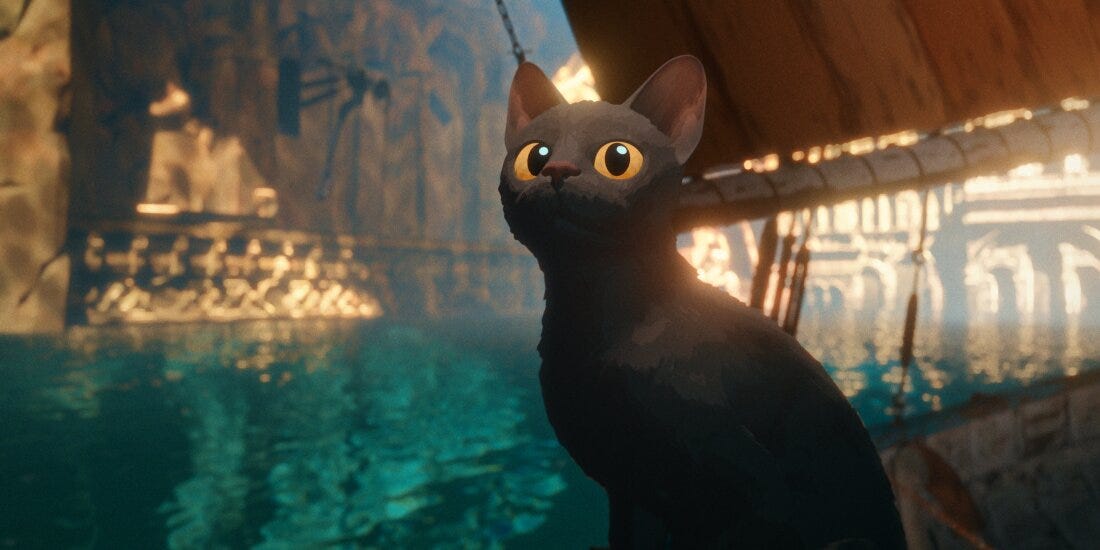
Image © Flow
Fox Renderfarm: Konstantins, regarding the visual style of Flow, what was the key technical approach that defined the movie's unique look?
Konstantins: The visuals were primarily defined by the concept artists. The director, of course, had his initial idea of how he wanted things to look. He invited an environment concept artist who modeled the look of the cities, mountains, and forests you see in the movie. We also had a character designer who created drawings of the characters, which I later modeled in 3D.
The visuals worked together in a loop. We would work on the models and the practical side of things, give it to the director, and he would give feedback on what was to his liking. It was a collaborative process.
Fox Renderfarm: What was the toughest compromise you had to make between artistic vision and technical limits?
Martins: The hardest part for me was animating the cat. In the end, that scene was redone because it needed too many adjustments, and the team already had an almost complete pipeline, thanks to their technical director. It was about making the cat behave like a cat.
Konstantins: For me, I wouldn't call them sacrifices. We chose to use real-time rendering (Eevee) instead of a path tracer (Cycles). That meant we knew the constraints from the start. This choice defined the look of the film and was actually what the director was going for. It allowed us to see changes instantly and deliver the project faster and cheaper.
Interviewer: What's the main advantage of using Blender for 3D pre-vis compared to traditional 2D storyboarding?
Konstantins: The inherent advantage of 3D is you get a correct perception of volume and spatial relationships. With 2D storyboarding, you often draw images that are physically impossible to film. In 3D, you see that immediately and can adjust the camera framing. For Flow, we didn't have a separate pre-vis phase because the director created the entire movie as an animatic from the start, giving us a very clear blueprint.
Interviewer: What advice would you give to newcomers pursuing CG and animation today?
Martins: Try to find what you personally like and expand on that. This is a competitive world. Copying means you'll be one among many. If you do your own thing, you might find unexpected, unique results. Don't be afraid of where it leads.
Konstantins: Watch movies—they are amazing inspiration for the new generation. Open Blender and experiment. You don't need to model everything; get free assets and follow tutorials on YouTube. Often, you can create amazing things just by playing with the software. Post your work online. The feedback you get is incredibly valuable—sometimes even more useful than praise is constructive criticism. Don't get discouraged by failure; a lot of failure makes the best artists.
Interviewer: Thank you both for such an insightful and inspiring conversation.