 Blender
 Cinema 4D
 Arnold
 3ds Max
 Houdini
 V-Ray
V-Ray Maya
Maya Unreal Engine
 Nuke
NukeBest Cloud Rendering Services for 3D Artists in 2026
 Ryan Thompson
The best cloud rendering service is not simply the one with the biggest hardware claim or the lowest headline price. For 3D artists and studios, the right choice depends on your software, render engine, CPU or GPU needs, deadline pressure, support quality, security requirements, and how easy it is to test a scene before sending the full job.
This guide compares several well-known cloud rendering services and explains how to choose between them. Use it as a practical checklist before uploading a Blender animation, Maya shot, Cinema 4D product render, Houdini simulation, 3ds Max architectural scene, or any other production render that cannot wait for a local workstation.
Quick Answer: Which Cloud Rendering Service Should You Choose?
For general 3D production, Fox Renderfarm is a strong all-around option because it supports both CPU and GPU rendering workflows, works with major DCC software, and is built for professional project delivery. If you need dedicated remote GPU machines, iRender may fit better. For V-Ray or Corona users who want a renderer-integrated workflow, Chaos Cloud is worth checking. For Blender hobby projects with no confidentiality concerns, SheepIt can be useful because it is community-based and free.
The safest approach is to choose two or three services that match your software, run a small frame range or test still, compare cost and output, then send the final job only after checking plugins, textures, caches, color management, and render settings.
What Is a Cloud Rendering Service?
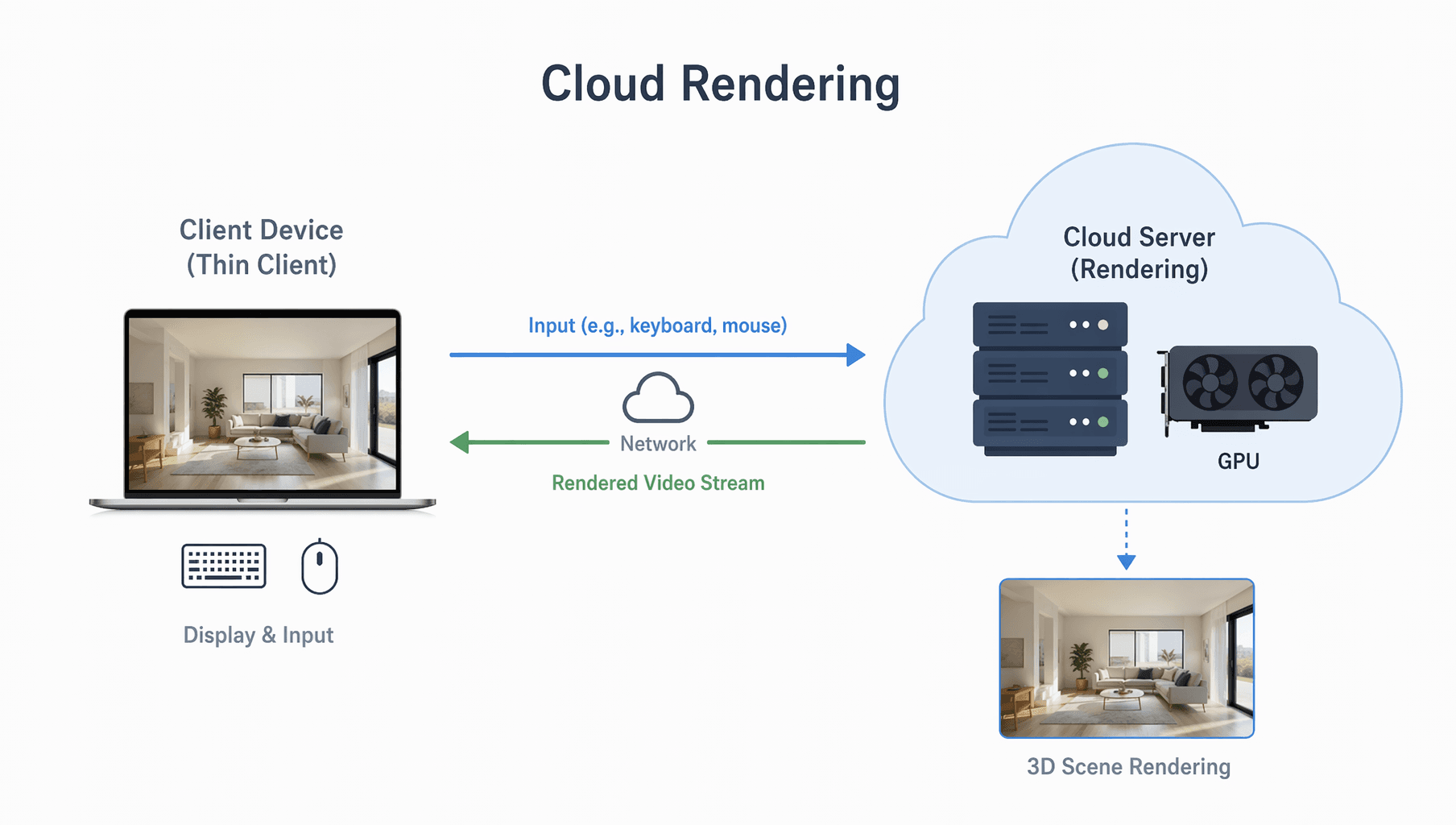
A cloud rendering service lets you process 3D frames on remote CPU or GPU machines instead of relying only on your local workstation. In practice, it gives artists access to more render capacity when a project becomes too heavy, too urgent, or too risky to finish locally.
If you are new to the concept, start with this guide to what cloud rendering is and how cloud rendering works. For a broader foundation, it also helps to understand what a render farm is and why studios use render farms for animation, VFX, architecture, games, and product visualization.
Cloud rendering services usually fall into three types:
|
Type |
Best For | Typical Workflow |
|
Managed render farm |
Artists who want to upload scenes and let the platform handle distribution | Install a plugin or client, submit the job, review test frames, render the final output |
|
Dedicated GPU server rental |
Users who want full control of a remote workstation | Rent a cloud machine, open your software remotely, render as if using a high-end local PC |
|
Renderer-integrated cloud rendering |
Artists using a specific renderer ecosystem | Submit directly from the supported renderer or connected tool |
How to Choose the Best Cloud Rendering Service
1. Start With Software and Renderer Compatibility
Do not begin with price. Begin with compatibility. Check your exact DCC software, renderer, plugin versions, frame output format, cache requirements, and operating-system assumptions.
A cloud render farm that supports "Blender" or "Maya" may still not support the exact version, plugin, or renderer build used in your scene. This is why professional artists usually submit a test frame before sending hundreds or thousands of frames.
2. Decide Whether You Need CPU, GPU, or Both
Some projects are built for CPU rendering. Others depend on GPU renderers or real-time engines. A few production pipelines need both. For example, a studio might use GPU rendering for previews but CPU rendering for final frames because of memory limits, plugin behavior, or renderer settings.
Choose a cloud rendering service that matches the actual render engine, not just the software name. If you are comparing render farms for Blender, Maya, Cinema 4D, 3ds Max, Houdini, V-Ray, Arnold, Redshift, Octane, or Corona, check the render engine support separately.
3. Estimate Cost With Real Test Frames
Render farm pricing can be hard to compare because services use different billing models: credits, GHz-hours, node-hours, GPU hours, server rental hours, or priority levels. A simple-looking price can become expensive if the scene has high samples, heavy displacement, large textures, high-resolution output, or slow simulation caches.
The practical method is simple: render one or several representative frames, then estimate the full job from that data. Fox Renderfarm also has a guide on how much a render farm costs per hour if you want a deeper cost-checking framework.
4. Check Security Before Uploading Client Work
For personal projects, security may be a minor concern. For commercial work, it matters. Before uploading a client scene, check how the cloud rendering service handles file transfer, storage, account access, project deletion, support permissions, and production confidentiality.
This is especially important for unreleased ads, game cinematics, film shots, product prototypes, architectural interiors, and branded visual assets.
5. Look at Support, Not Just Hardware
Raw hardware only helps if the job actually renders correctly. Good support can save hours when a scene fails because of missing assets, unsupported plugins, path errors, broken caches, incorrect frame ranges, color shifts, or licensing differences.
For tight deadlines, choose a service that can help you diagnose failed frames quickly. A cheaper render farm with slow support can become expensive if it delays delivery.
1. Fox Renderfarm
Fox Renderfarm is a professional cloud rendering service built for artists and studios. It supports both CPU and GPU rendering, works with major 3D software such as Maya, 3ds Max, Blender, Cinema 4D, Houdini, and Unreal Engine, and offers flexible submission through the web, desktop client, and software plugins.
Useful production features include automatic scene analysis, cost estimation, test rendering, batch submission, automatic download, and 24/7 technical support. Fox Renderfarm can fit architectural visualization, animation, VFX, product visualization, motion graphics, and game cinematics, while also offering TPN-accredited security for all work.
Use Fox Renderfarm when:
-
You need a managed render farm rather than a remote desktop machine.
-
Your project uses mainstream 3D softwares such as Maya, 3ds Max, Blender, Cinema 4D, or Houdini.
-
You want to test frames before committing to the full render.
-
You need support during scene submission, plugin checks, or render troubleshooting.
-
You want a professional cloud rendering option with published pricing and workflow documentation.

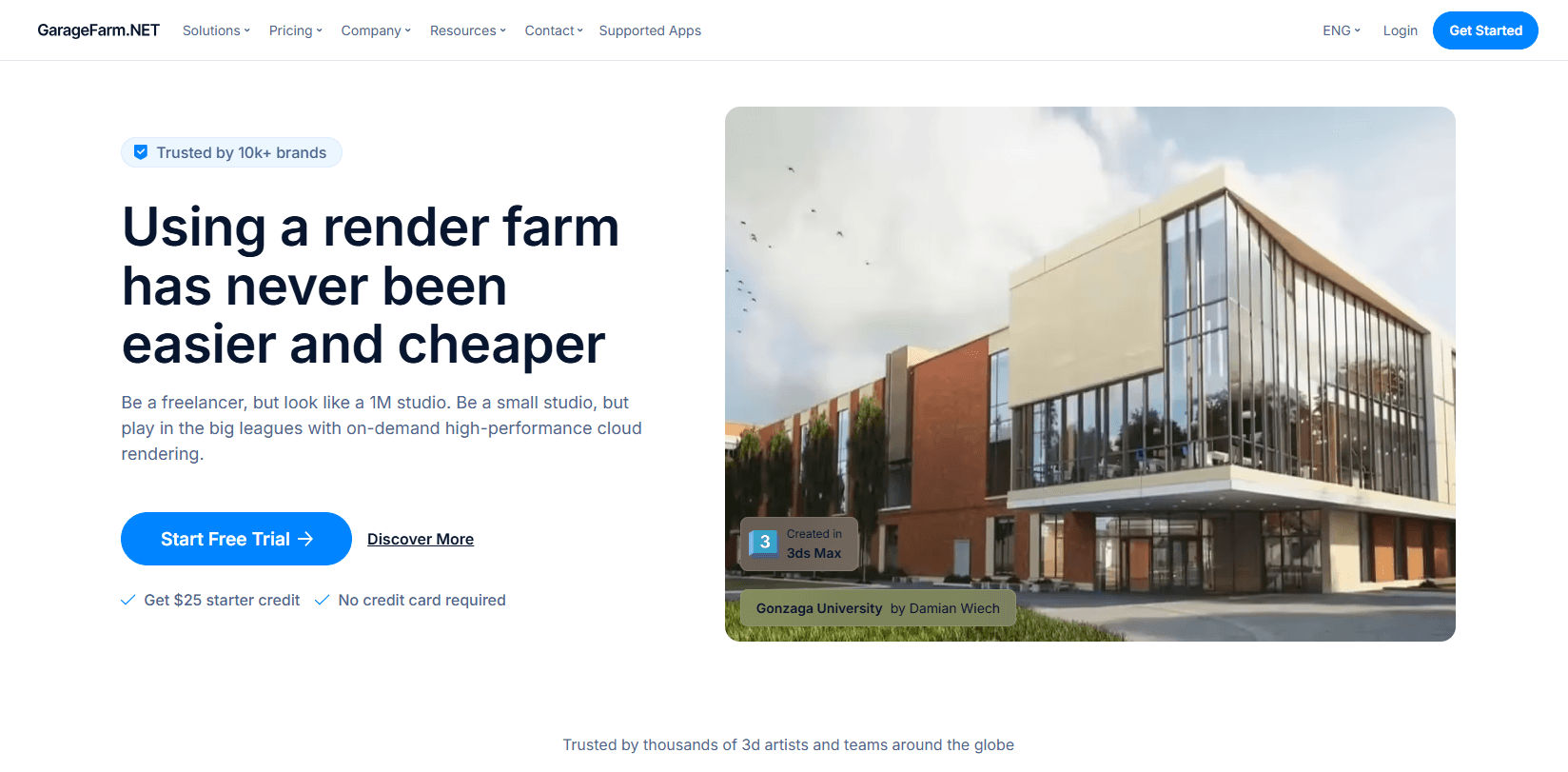
2. GarageFarm.NET
GarageFarm.NET is a long-running render farm service often considered by artists who want a guided submission process and a balance between cost, support, and queue options. It can be a good fit for freelancers, small studios, architectural visualization teams, and animation projects that need help getting scenes prepared for cloud rendering.
Its strength is accessibility. For artists who have never used a cloud render farm, a service with clear setup guidance and responsive support can save time, especially when scenes include missing textures, unsupported plugins, unusual paths, or render settings that behave differently outside a local machine.
3. RebusFarm
RebusFarm is another established render farm service used for common 3D production workflows. It is often considered for projects made in mainstream DCC software with render engines such as V-Ray, Corona, Arnold, Redshift, Octane, and other widely used production tools.
The main reason to consider RebusFarm is compatibility breadth. If your project depends on a particular software, renderer, or plugin combination, check whether the exact version is supported before uploading a final job. A render farm can be fast, but version mismatches are still one of the quickest ways to lose time.
RebusFarm may be a good option for freelancers and studios that want a conventional render farm workflow: install the submission tool, prepare the scene, estimate the cost, submit test frames, and then run the full sequence.

4. Ranch Computing
Ranch Computing is a professional render farm service with a focus on CPU and GPU rendering for 3D production. It can be relevant for studios that need a reliable managed render farm and want to compare support, software coverage, security, and regional requirements.
This service is especially worth checking if your team has specific production, privacy, or client-delivery requirements. For commercial projects, do not choose a render farm only by price. Ask how the service handles uploaded assets, project storage, data deletion, support access, and failed-frame troubleshooting.

5. iRender
iRender is different from many managed render farms because it focuses heavily on remote GPU server rental. Instead of only submitting a render job through a render farm manager, users can rent a powerful remote machine and control the software environment more directly.
That model is useful for GPU rendering, simulation previews, interactive work, real-time engines, or workflows where you need access to a full high-end machine rather than a traditional farm queue. It may suit users working with GPU renderers such as Redshift, Octane, V-Ray GPU, Cycles GPU, or Unreal Engine.
The tradeoff is that a remote server workflow requires more hands-on management. You need to think about setup time, storage transfer, remote desktop performance, hourly billing, software licensing, and whether your team is comfortable controlling the render environment manually.

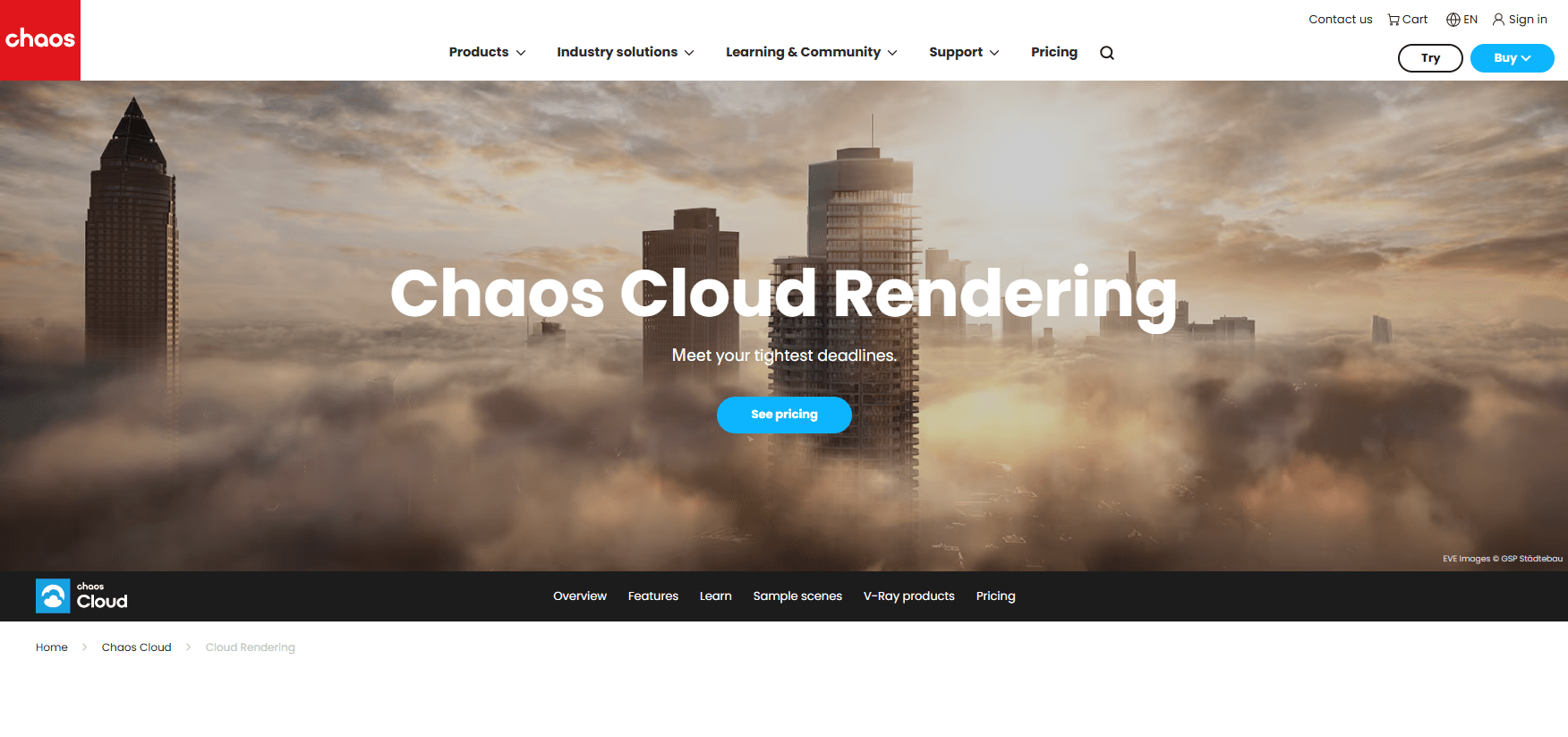
6. Chaos Cloud
Chaos Cloud is a natural option for artists already working inside the Chaos ecosystem, especially V-Ray and Corona workflows. Its value is convenience: if your renderer and host application are supported, cloud submission can feel more direct than preparing a scene for a separate third-party farm.
This makes Chaos Cloud appealing for architectural visualization, product visualization, interiors, and commercial stills or animations where V-Ray or Corona is already the core renderer. It is not necessarily the broadest solution for every DCC pipeline, but it can be efficient when the project matches the supported workflow.
7. GridMarkets
GridMarkets is often associated with cloud rendering and simulation workflows for heavier production scenes, including VFX-oriented pipelines. It can be relevant when a project involves Houdini simulations, large caches, high-resolution assets, or other workloads where upload size and pipeline support matter as much as raw render speed.
For these projects, the biggest question is not only "How fast can it render?" It is also "Can the service handle the full scene package without breaking the pipeline?" Simulation caches, file paths, dependencies, and storage requirements should be tested early.
GridMarkets is worth considering for technical artists, VFX teams, and studios that need cloud capacity for more than simple frame rendering.
8. SheepIt
SheepIt is a community-based render farm for Blender. It can be useful for students, hobbyists, and non-commercial Blender projects where cost is the main concern and the scene is safe to share through a community system.
The advantage is obvious: it is free. The limitation is equally important: it is not the best fit for confidential client work, commercial assets, strict deadlines, or pipelines that need professional support. Queue behavior and available power depend on the community, so it should not be treated like a guaranteed production render farm.
Use SheepIt for experiments, personal shots, and learning. For client work or urgent delivery, a professional cloud rendering service is usually safer.

Which Cloud Rendering Service Fits Your Workflow?
|
Workflow |
Recommended Direction |
|
Animation or VFX sequence with many frames |
Use a professional managed render farm such as Fox Renderfarm, GarageFarm.NET, RebusFarm, or Ranch Computing |
|
GPU-heavy rendering or remote workstation needs |
Compare iRender with GPU-capable render farm services |
|
V-Ray or Corona architectural visualization |
Compare Chaos Cloud with other V-Ray/Corona-compatible render farms like Fox Renderfarm |
|
Blender personal project with no confidentiality concerns |
Try SheepIt or compare free-trial options from professional services |
|
Houdini simulation or cache-heavy VFX work |
Check Fox Renderfarm, GridMarkets and other services with strong pipeline support |
|
Client project with strict deadline |
Choose based on compatibility, support, security, and test-frame results, not price alone |
How to Test a Cloud Rendering Service Before the Final Job
Before sending the full render, use this checklist:
-
Upload a small version of the actual production scene.
-
Render one still or a short frame range, not only a simple benchmark file.
-
Compare the cloud output with your local output for lighting, color, missing assets, and motion blur.
-
Check the estimated cost after the test frame.
-
Confirm the frame range, camera, output format, resolution, samples, denoising, and render layers.
-
Check failed-frame handling and support response if anything breaks.
-
Only then submit the full sequence.
This small test can prevent expensive mistakes. It is especially important when a deadline is close and there is no time to rerender the full shot twice.
FAQ About Cloud Rendering Services
Are cloud rendering services worth it?
Yes, cloud rendering services are worth it when local rendering would take too long, block other workstations, or put a deadline at risk. They are most valuable for animation sequences, high-resolution stills, complex lighting, heavy simulations, and client projects with revision pressure.
What is the difference between cloud rendering and a render farm?
Cloud rendering is the broader idea of rendering through remote computing resources. A render farm is one common way to do it: many connected machines process frames or tasks in parallel. Some services use a managed render farm model, while others provide dedicated remote GPU servers.
Is GPU cloud rendering better than CPU cloud rendering?
Not always. GPU cloud rendering can be faster for GPU renderers and interactive workflows, but CPU rendering may be better for scenes with very high memory needs, certain production renderers, or plugin requirements. The best choice depends on the renderer and the scene.
>> Related: CPU Rendering vs. GPU Rendering: How to Choose?
Can I use a cloud render farm for Blender?
Yes. Many cloud rendering services support Blender, but you should check the exact Blender version, render engine, add-ons, linked assets, and output settings before submitting a full job. For personal projects, SheepIt is a free community option; for commercial work, a professional render farm is usually safer.
How much does cloud rendering cost?
Cloud rendering cost depends on render time, machine type, priority level, software, renderer, scene complexity, and billing model. The most reliable estimate comes from rendering a representative test frame and scaling the result to the full frame count.
Final Recommendation
If you are choosing the best cloud rendering service for a real project, do not treat comparison lists as a final answer. Use them to narrow your options. Then test your own scene, compare output accuracy, check pricing, and confirm support before the final submission.
For artists and studios that need a flexible professional render farm, Fox Renderfarm is a strong option to include in that shortlist. For dedicated remote GPU work, compare iRender. For V-Ray or Corona projects, check Chaos Cloud. For free Blender experiments, SheepIt may be enough. The best cloud rendering service is the one that renders your actual scene correctly, securely, and on time.

 Ryan Thompson