 Blender
 Cinema 4D
 Arnold
 3ds Max
 Houdini
 V-Ray
V-Ray Maya
Maya Unreal Engine
 Nuke
Nuke4 Best GPU and CPU Render Farms for 3D Projects in 2026
 Ryan Thompson
Choosing the best render farm can make a huge difference when you are working on animation, VFX, architectural visualization, or product rendering. If your local machine struggles with long render times, large frame sequences, or complex lighting setups, a professional GPU render farm or CPU render farm can help you finish projects faster and more efficiently.
In this guide, we compare 4 popular GPU and CPU render farms and explain what to look for when choosing the right solution for your workflow. Whether you need a render farm for Blender, Maya, Cinema 4D, or Redshift, this article will help you evaluate the most important factors before you submit your next project.
Why Do You Need a Render Farm?
Rendering is one of the most time-consuming stages in any 3D pipeline. Every frame in an animation must calculate lighting, shadows, reflections, textures, and effects before the final output is complete. The more detailed the scene, the more processing power and time are required.
A one-minute animation at 30 frames per second contains 1,800 frames. If a single frame takes 10 minutes to render on a local workstation, the full sequence may require around 13 days of nonstop rendering. During that time, your computer stays under heavy load and may be unavailable for other creative work.
That is why many artists and studios turn to a cloud rendering service. Instead of investing heavily in additional hardware, electricity, maintenance, and software licenses for multiple machines, you can use a GPU render farm or CPU render farm only when you need extra power. This approach helps reduce turnaround time, improve scalability, and control rendering costs.
GPU Render Farm vs CPU Render Farm
Before choosing a service, it is important to understand the difference between GPU rendering and CPU rendering.
What Is a GPU Render Farm?
A GPU render farm uses graphics processing units to accelerate rendering tasks. It is often preferred for workflows that depend on render engines such as Redshift, Octane, or GPU-accelerated Blender Cycles setups. A GPU render farm is usually the best option when speed is the top priority and your software supports GPU rendering efficiently.
What Is a CPU Render Farm?
A CPU render farm relies on processors instead of graphics cards. CPU rendering is still widely used in many production pipelines, especially for projects built with Arnold, V-Ray CPU, Corona, and other CPU-based engines. A CPU render farm may also offer better compatibility for scenes, plugins, and pipelines that are not fully optimized for GPUs.

>> Learn More: CPU vs GPU Rendering: Which Is Better for Your Projects?
How to Choose the Best Render Farm in 2026
The best render farm is not always the cheapest one. A good choice depends on your software, renderer, project scale, budget, and workflow needs.
1. Ease of Use
A smooth submission process can save a lot of production time. Look for a render farm that supports multiple submission methods such as desktop clients, web portals, or plugins for major 3D software. Easy uploads, clear job monitoring, and stable asset handling are all important for efficient cloud rendering.
2. SaaS vs IaaS
Some services operate as SaaS platforms, where you upload a project and let the provider manage the rendering process. These are generally easier for artists and small teams.
Others use an IaaS model, which gives you remote access to dedicated machines or servers. IaaS solutions provide more control and flexibility, especially for technical users, custom pipelines, and large-scale production environments.
3. Software and Plugin Compatibility
Always check whether the service supports your exact 3D software, render engine, and plugin versions. This is essential for Blender, Maya, Cinema 4D, 3ds Max, Houdini, and similar tools. Compatibility issues can slow down production or cause rendering errors.
4. Pricing Transparency
A good cloud rendering service should provide clear pricing, realistic estimates, and no unexpected hidden costs. Free trials, online calculators, and discounts can also help you test a render farm before committing to larger projects.
5. Rendering Speed and Resource Availability
Rendering speed depends on more than raw hardware. It also depends on how many nodes are available, how jobs are queued, and whether the farm offers suitable CPU or GPU options for your scene.
6. Support and Security
Fast technical support matters when deadlines are tight. Strong documentation, responsive support teams, secure file transfer, and privacy protection are all valuable when choosing the best render farm for professional work.
Top 4 Best GPU and CPU Render Farms
Below is a practical comparison of four well-known render farm providers for 3D artists, freelancers, and studios.
1. Fox Renderfarm
Fox Renderfarm is a well-established cloud rendering service that offers both GPU and CPU rendering for a wide range of 3D production needs. It supports many major 3D applications and render engines, making it a strong option for artists who work across multiple tools and need a scalable render farm for professional projects.

Pros
- Offers both GPU render farm and CPU render farm services
- Free $25 trial credit for new users
- Supports web submission, desktop client submission and plugin submission
- Compatible with many mainstream 3D software packages and renderers
- Competitive pricing for different project sizes
- 24/7 technical support
- Supports free data transfer tools
Cons
- Primarily SaaS-based
2. RebusFarm
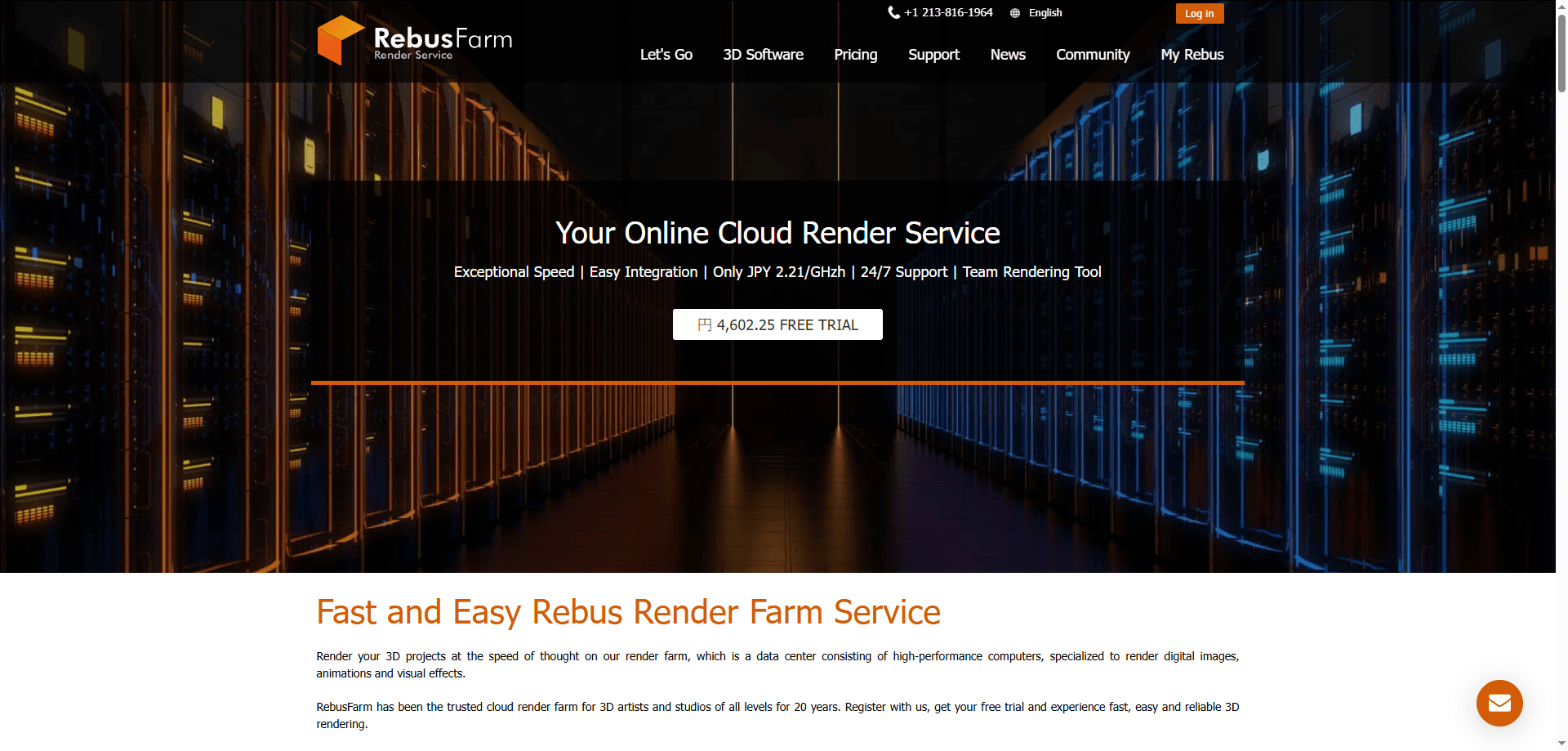
RebusFarm is a long-running render farm known for its broad software support and accessible workflow. It provides both CPU and GPU rendering and is often considered by artists who want a reliable service with clear job submission tools and strong CPU rendering support.
Pros
- Supports both GPU and CPU cloud rendering
- Free trial credit for new users
- User-friendly submission workflow
- Broad support for popular 3D applications
- 24/7 customer support
Cons
- SaaS model only
3. GarageFarm
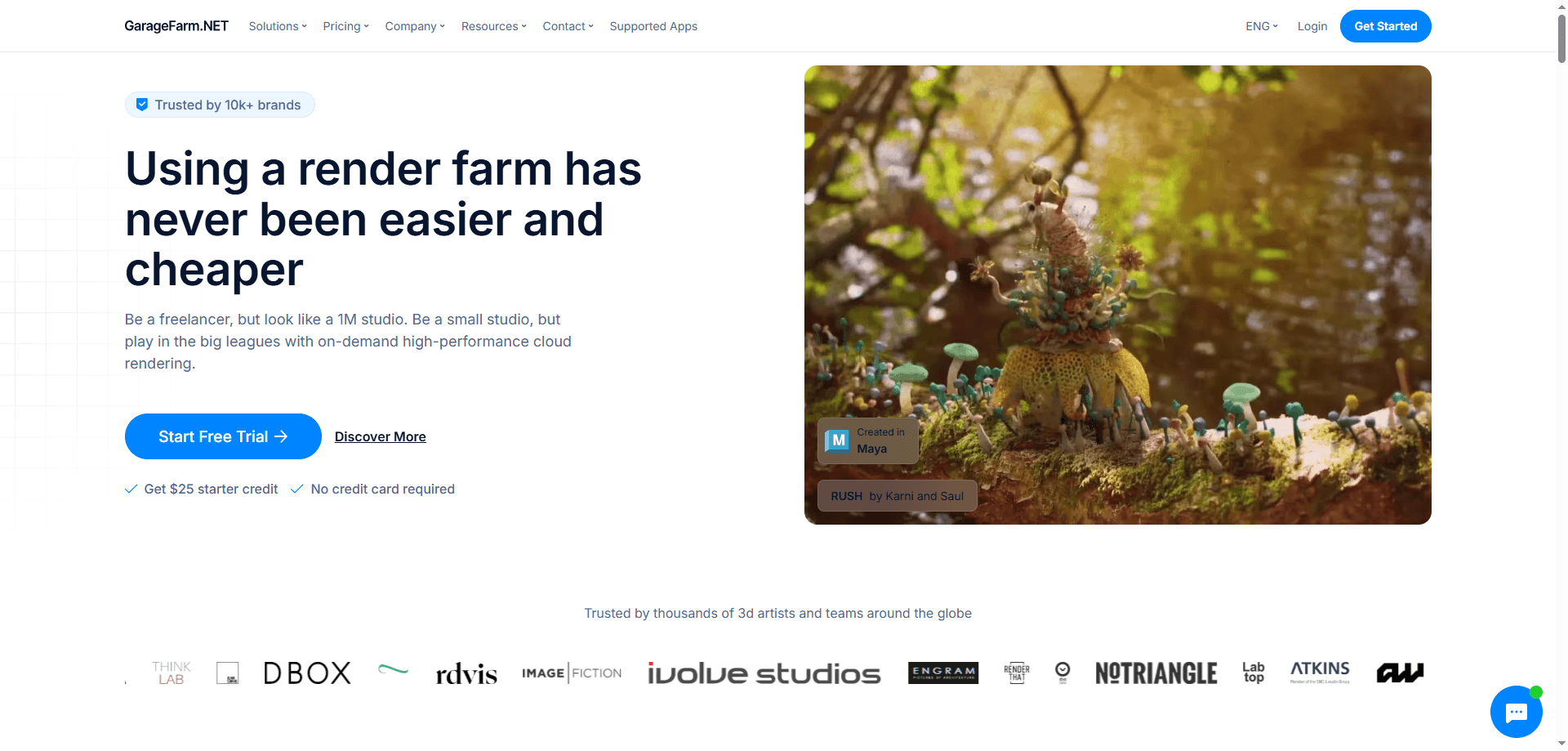
GarageFarm is another widely used cloud rendering service for artists who need flexible rendering options across different 3D applications. It offers both SaaS and selected IaaS-style flexibility, which may appeal to users who want broader workflow choices.
Pros
- GPU and CPU render farm services available
- Supports many major 3D packages
- Free trial credit for new users
- Strong tutorials and community resources
- 24/7 support
Cons
- Animation cost estimation can be limited in some cases
- Upload and UI workflow may feel complicated for beginners
- OctaneRender via SaaS is not always supported
- Free data transfer is not available for all IaaS users
4. iRender
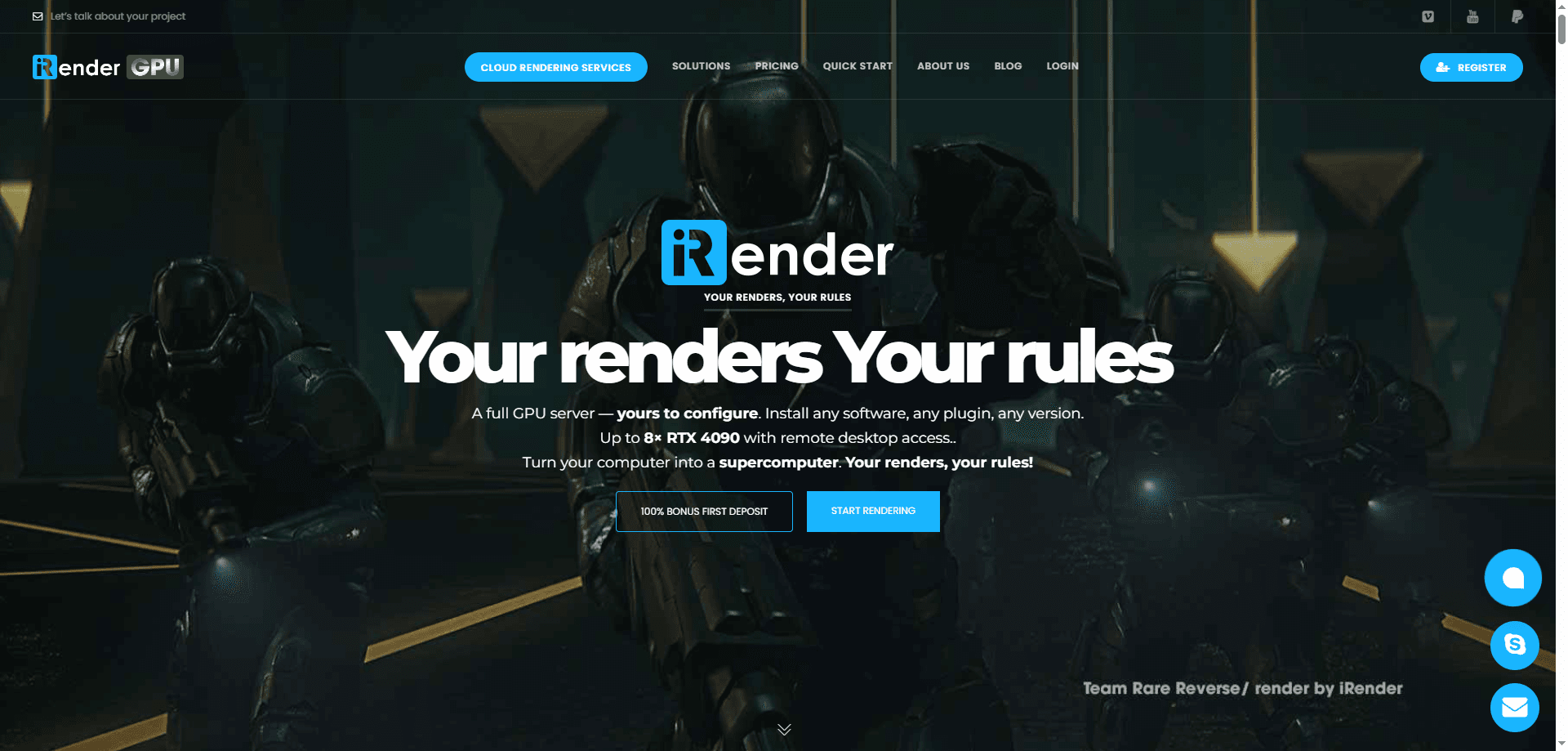
iRender is best known for its IaaS approach. Instead of a traditional managed queue system, it gives users access to remote machines where they can install and configure their own applications. This makes it attractive for advanced users who want more control over their rendering environment.
Pros
- Full control over remote machine configuration
- Supports applications running on Windows or Ubuntu
- Supports free data transfer tools
- Lets users store workspaces for repeat usage
- Useful for GPU-heavy workflows and custom setups
- 24/7 support
Cons
- More limited FAQ documentation
- IaaS-only model may be less beginner-friendly
- Supports GPU rendering only
Best Render Farm for Blender
If you are searching for a render farm for Blender, the following services are strong options:
1. Fox Renderfarm
2. RebusFarm
3. GarageFarm
A good Blender render farm should support stable file submission, texture and asset management, and compatibility with Blender versions and render engines such as Cycles.
>> Learn More: Best Blender Render Farm in 2026: 8 Free & Paid Picks
Best Redshift Render Farm
For artists using Redshift in Maya, Cinema 4D, Blender, or other 3D software, these services are often considered among the top options:
1. Fox Renderfarm
2. iRender
3. RebusFarm
If your workflow depends heavily on GPU acceleration, choosing the right Redshift render farm can help reduce render times while maintaining production flexibility.
>> Learn More: 5 Best Redshift Render Farm: Maximize Speed and Efficiency
Final Thoughts
The best GPU render farm or CPU render farm for your project depends on your software, rendering engine, budget, and preferred workflow. If you need a balanced cloud rendering service with wide software support, professional-grade infrastructure, and both CPU and GPU options, Fox Renderfarm is a solution worth considering.
For artists and studios handling demanding 3D rendering tasks, cloud rendering can save significant time and reduce the cost of scaling production in-house. If you want to test the workflow before committing, Fox Renderfarm offers a free $25 trial for new users, making it easier to evaluate whether the platform fits your pipeline.