
 Blender
 Cinema 4D
 Arnold
 3ds Max
 Houdini
 V-Ray
V-Ray Maya
Maya Unreal Engine
 Nuke
Nuke3D Rendering for Marketing: Faster Visuals for Modern Campaigns
 Ryan Thompson
Modern marketing campaigns need fast and high-quality visual content, but traditional photoshoots can be expensive, slow, and difficult to scale. This is why 3D rendering for marketing has become a popular solution for brands and creative teams.
With 3D rendering, companies can create photorealistic product images and animations directly from digital assets without waiting for physical prototypes. This guide explains how 3D rendering for marketing helps improve campaign speed, flexibility, and visual quality for modern advertising and product promotion.
Part 1. What Is 3D Rendering in Marketing?
3D rendering marketing is the process of using specialized software to convert 3D models into highly detailed 2D images or videos. In marketing, this means taking a digital blueprint of a product and adding textures, lighting, and environments to make it look like a real photograph.
Teams are ditching cameras for computers because 3D visuals offer total control. During this, you can change a product’s color, adjust the scene’s lighting, or swap out a background in seconds.
Part 2. 5 Common Uses of 3D Rendering in Marketing
The marketing team leverages 3D rendering to bypass the limitations of physical photography, allowing for perfect control over the environment and lighting. Given this importance, here are 5 common ways 3D marketing renderings are used to drive modern campaigns:
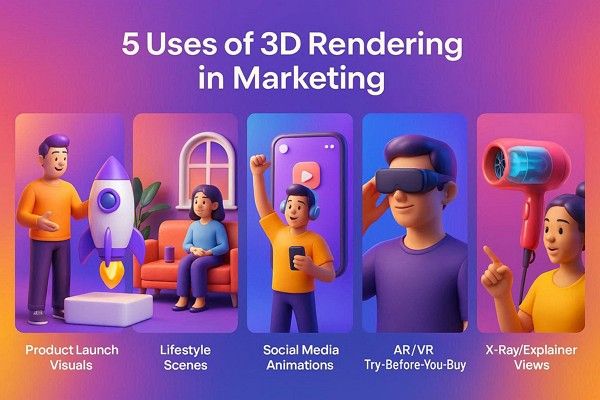
- Pre-Visualizing Product Launches: Brands often need marketing assets a month before a physical product leaves the factory. Thus, 3D rendering allows teams to create hyper-realistic images and videos from CAD designs to ensure ads are ready the moment the product is available.
- High-End Lifestyle Imagery: Instead of renting luxury mansions or flying crews to exotic locations, marketers use 3D rendering to place the product in any setting. This allows a piece of furniture to be photographed in a sun-drenched penthouse or a cozy cabin without ever leaving the studio.
- Animated Social Media Content: 3D animation is a staple for eye-catching social media ads, whether it's a shoe assembling itself or a mid-air simulation of a beverage. In both content-making situations, 3D marketing renders grabs attention more effectively than standard video.
- Interactive AR and VR Experiences: Unlike traditional animations, 3D rendering enables “Try Before You Buy” experiences. For example, furniture retailers use AR to let customers place a realistic 3D sofa model directly in their living room using a smartphone camera.
- Technical X-Ray and Explainer Videos: Standard cameras cannot see through solid objects, and 3D rendering allows marketers to create exploded videos or transparent animations. This shows the internal technology of a car engine or the layers of a high-tech running shoe.
Part 3. 5 Benefits of 3D Rendering for Campaigns
3D rendering animation helps marketing by creating immersive, realistic visuals that attract attention, engage viewers, and drive conversions more effectively than static images. Using 3D rendering solutions for marketing firms provides a competitive edge by removing the physical and financial constraints of traditional photography. If you have decided to use this type of rendering in marketing, the following are the 5 benefits you will avail:
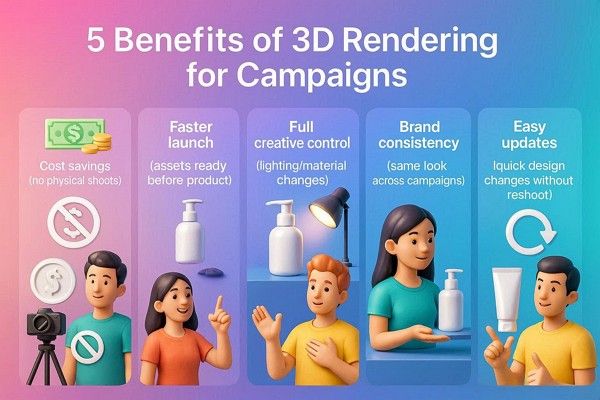
- Significant Cost Savings: Traditional photoshoots require renting space, hiring crews, and shipping physical prototypes. However, with 3D rendering, the entire set is digital, and once the model is created, it can be reused in an infinite number of scenes without recurring costs.
- Faster Time-to-Market: In this fast-paced world of digital marketing, speed matters, and 3D rendering allows teams to deliver high-quality marketing assets while the product is being manufactured. This ensures that the promotional material is ready for launch day, rather than weeks later.
- Total Creative Control: In a 3D environment, the photographer has greater control, as you can change the weather, adjust the sun's position, or swap the product's material from matte to glass. Hence, this god-like control and level of precision are impossible to achieve in the real world, making product marketing more effective and versatile.
- Effortless Brand Consistency: Maintaining a consistent look across a global campaign is challenging with photography. Therefore, 3D rendering ensures that every set, whether a social media post or a billboard, uses the same lighting, camera angles, and color profiles to create a unified brand identity.
- Easy Updates and Revisions: If a product’s logo or packaging design changes at the last minute, you don’t have to reshoot. Instead, simply update the digital texture on the 3D model, and the software can automatically re-render all the existing campaign images with new designs.
Part 4. 5 Challenges in 3D Rendering for Marketing
The future of 3D rendering is driven by AI, real-time processing, and cloud technology, making it faster, more accessible, and increasingly immersive across industries. While 3D commercial renders offer incredible flexibility, they aren’t without their hurdles. This shift from traditional to 3D first workflow requires overcoming several technical and logistical challenges, as follows:
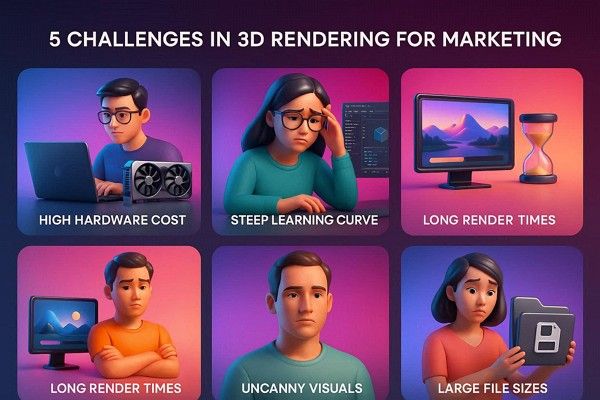
- Large First Hardware Cost: Producing photo-real images and 4K animation takes enormous computing power. Therefore, general office laptops do not have the high-end GPUs and RAM required to work with detailed textures and lighting, which makes them expensive.
- Steep Learning Curve: It takes years of experience to master professional software and 3D suites such as Blender, 3ds Max, or Cinema 4D. Marketing departments will need to pay a lot of money to train their employees and employ 3D artists, which may be an obstacle in small agencies.
- Long Rendering Times: A single high-quality frame can be rendered in hours, even with powerful hardware. In the case of a 30-second animation, it might require massive processing time on a single machine, which causes bottlenecks when campaign deadlines need to be met.
- The Uncanny Valley: When a render is not carried out flawlessly, it may appear almost real, but with a slight deviation, which may put the customers at ease. Therefore, a high level of artistic skill is needed to create the ideal combination of micro textures and natural light so that it does not produce this uncanny effect.
- Large File Sizes: Full-color 3D output and raw point-cloud files can take up terabytes of storage. As such, storing these files, sharing them with remote teams, and ensuring backups require a well-developed IT infrastructure.
Part 5. 5 Tips to Use 3D Rendering Effectively in Marketing
You must strike a balance between creativity and great efficiency to maximize the effectiveness of the 3D visualization service for the marketing agencies. Along with these combinations and by implementing the 5 tips given below, your team will be able to produce high-quality visuals while meeting tight deadlines:
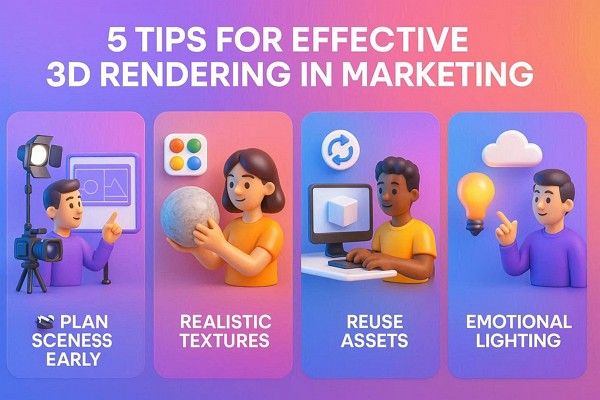
- Design Your Scenes: Use your 3D space like a real-world set and easily adjust camera angle, lighting, and shots. By this, you save the expensive and time-consuming revisions made later in the production cycle.
- Focus on Photorealistic Textures: The distinction between the unprofessional appearance and the professional one is in the details. Therefore, apply high-quality PBR materials to imitate micro scratches, dust, and realistic light reflections to make your product indistinguishable from a photograph.
- Recycle Assets to Multi-Channel Content: Understand that one of the most powerful aspects of 3D visual content is its multi-channel potential. Therefore, create a high-quality 3D model that produces print, short loops, and interactive models to maintain brand consistency across all media.
- Use Lighting to Elicit an Emotional Response: Lighting is not only about visibility, but also about telling a story, and Three-Point Lighting can be used to explain products. Otherwise, apply dramatic Rim Lighting to accentuate smooth lines to assist in establishing an emotional bond with the consumer.
- Render Farms Large-Scale Projects: Local hardware must not be overloaded by high-resolution animations and sophisticated 3D scenes, which can take weeks to complete. Thus, with the help of such a service as Fox Renderfarm, it is possible to spread the load among thousands of high-performance CPU and GPU nodes.
It integrates seamlessly with whether your team is using Rhino 8, Blender, 3ds Max, or Cinema 4D, and with engines such as V-Ray, Corona, or Octane. This guarantees that your current 3D rendering marketing platform is not compromised and has TPN-certified security measures.
Frequently Asked Questions
1. Is 3D rendering better than traditional photography?
In terms of flexibility, cost, and speed, 3D rendering allows for changes in lighting, color, and environment that are impossible or too expensive to achieve in a physical photoshoot.
2. How long does it take to render a 3D marketing image?
Ideally, a single image can take from a few minutes to several hours, depending on the complexity and your hardware. Therefore, exports suggest using farms like Fox Renderfarm to render scenes across thousands of CPU and GPU nodes.
3. Can I use 3D renders for social media?
Yes, 3D renders are ideal for creating eye-catching, high-resolution social media content that stands out in crowded feeds. Beyond simple aesthetics, product loops are specifically designed to stop thumb-scrolling and drive higher engagement rates than standard videos.
Conclusion
3D rendering for marketing is the ultimate tool for brands that need high-impact, flexible visuals at scale. Thus, by moving beyond the physical constraints of traditional photography, this guide has highlighted use cases, benefits, and possible challenges of 3D marketing rendering. Just to ensure your campaign never misses any deadline due to hardware limitations, Fox Renderfarm can distribute frames across hundreds of servers to complete the job quickly.



 Ryan Thompson